
Case Study

The Decarbonator’s Impact on Hood Filter Cleaning

Why the Decarbonator® is
a Game-Changer for
Commercial Kitchens

Clean and well-maintained hood filters are essential for the efficiency and safety of commercial kitchens. This case study evaluates the effectiveness of the Decarbonator®, a specialized cleaning system designed to remove stubborn Fats, Grease and Grime (FGG) from hood filters—contaminants that traditional cleaning methods often leave behind.

Background

In commercial kitchens, airborne FGG particles settle on surfaces, creating safety hazards and operational inefficiencies:
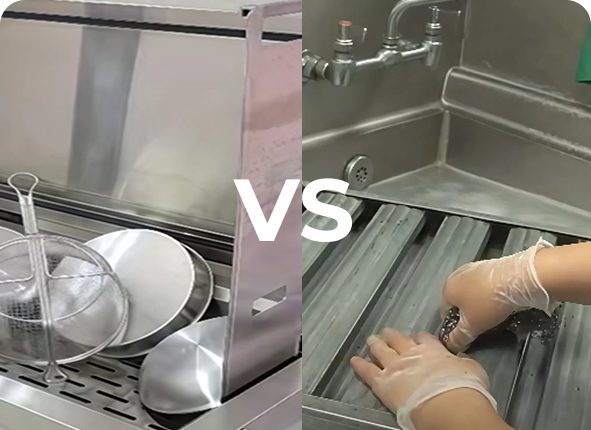
  • Increased Fire Risk: Grease buildup in filters can lead to dangerous kitchen fires.
  • Slip and Fall Hazards: Residual grease on floors increases workplace accidents.
  • Higher Utility Costs: Clogged filters force HVAC systems to work harder, raising energy consumption.
  • Ineffective Cleaning Methods: Traditional methods, such as manual scrubbing and dishwashers, may not fully remove grease trapped in hood filter baffles.
  • This study aimed to compare the Decarbonator® against conventional cleaning methods to determine its effectiveness in deep-cleaning hood filters.

Objective

To quantify how much FGG is removed from a commercial kitchen hood filter using the Decarbonator® compared to conventional cleaning methods.

Methodology

1

Selection of Hood Filter

A dirty hood filter was taken from a commercial kitchen for testing.

2

Weighing the Filter

The initial weight of the hood filter was recorded before any cleaning.

3

Conventional Cleaning Process

  • The filter was soaked in a hot water degreaser solution and manually scrubbed for 15 minutes.
  • The filter was then weighed again to measure the amount of grease removed.

4

Decarbonator® Cleaning Process

  • The same filter was then placed in the Decarbonator® for 30 minutes.
  • The filter was weighed again after cleaning to measure the additional FGG removed.

Results

Cleaning Stage

Weight (lbs)

FGG Removed (lbs)

Initial Weight (Dirty Hood Filter)

7.94 lbs

After Conventional Cleaning

7.72 lbs

0.22 lbs

After Decarbonator® Cleaning

7.50 lbs

Additional 0.22 lbs

Key Findings

In commercial kitchens, airborne FGG particles settle on surfaces, creating safety hazards and operational inefficiencies:

  • Conventional cleaning removed only 0.22 lbs of FGG.
  • The Decarbonator® removed an additional 0.22 lbs of hidden grease left behind by manual scrubbing.
  • The total amount of grease removed was 0.44 lbs, proving that traditional methods leave behind a significant amount of FGG.

Discussion

The Decarbonator®’s effectiveness in eliminating hidden grease highlights its advantages over conventional cleaning methods:

  • More Thorough Cleaning: Reaches deep within hood filter baffles where scrubbing fails.
  • Reduced Labor Costs: Eliminates the need for time-consuming manual scrubbing.
  • Improved Safety & Efficiency: Reduces fire hazards, slip risks, and HVAC strain.

Conclusion

The Decarbonator® is a highly effective and cost-efficient cleaning solution for hood filters in commercial kitchens. It not only removes visible grease but also eliminates hidden FGG, ensuring a safer and more energy-efficient kitchen.

Recommendation

Commercial kitchens should incorporate the Decarbonator® into their regular hood filter cleaning routines to:

  • Improve safety & compliance
  • Reduce labor & cleaning time
  • Lower utility & maintenance costs

Upgrade your kitchen cleaning
process today

Schedule a consultation to learn more!